top of page

Recent Posts

Archive

Tags

Rebuild Green Hackathon 2026 у цифрах
29 countries • around 100 experts, stakeholders and beneficiaries • 65+ selected participants • 7 real challenges • 6 regions of Ukraine • 7 international interdisciplinary teams • 12 mentors • 4 weeks of work • Demo Day on 31 October

On 3 October, Rebuild Green Hackathon 2026 launched as the second cycle of the international Rebuild Green 2030 programme. This year, the programme has brought together around 100 experts, representatives of different stakeholder groups and beneficiaries from 29 countries around seven real challenges facing Ukrainian communities.


More than 65 participants were selected from applications submitted by international experts and Ukrainian professionals from different disciplines. Over four weeks, they will work in international interdisciplinary teams together with communities, mentors and experts, transforming real local problems into solutions capable of progressing towards acceleration, financing and practical implementation.


The Hackathon is part of Rebuild Green 2030 — a long-term programme developed by FIABCI-Ukraine and SYNCHRO SPACE in partnership with Modulina Straw Panels and an international network of partners.


From the First Hackathon to Rebuild Green 2030


The Hackathon was opened by Alissa Bankovska, Co-Founder of Rebuild Green 2030, CEO of SYNCHRO SPACE and President of FIABCI-Ukraine. She presented the programme’s logic, the format of its second cycle and the results of the first Rebuild Green Hackathon in 2024.

Rebuild Green Alissa Bankovska

The experience of the first cycle became the foundation for developing a new model. It demonstrated that a team formed around a specific municipal challenge can continue to exist after the competition ends, while a concept created during the Hackathon can evolve into a pilot project, an international partnership or a consortium.

That is why, in 2026, Rebuild Green is structured as a much longer pathway:

challenge → interdisciplinary team → concept → pilot → acceleration → consortium → financing → implementation.

Within this model, Demo Day is not the final destination, but a potential starting point for the next stage in the life of a project.


From Challenge to Implementation: The International Framework of the Opening Day

The first substantive block of the opening was entitled From Challenge to Implementation. This was intentional: even before the seven municipal cases were presented, participants were invited to look at a recovery project not only as an architectural or engineering solution, but as a long-term system — involving people, governance, financing, responsibility and measurable outcomes.


Antonio Campagnoli: From PPP to 5P

Rebuild Green Antonio Campagnoli

Antonio Campagnoli, Immediate Past World President of FIABCI and Founder of IL PUNTO Real Estate Advisor, proposed expanding the traditional Public-Private Partnership model into the following formula:

Public — Private — People — Policy — Partnership.

At the centre of this approach are people.

A community should not be merely the end user of an already completed facility. People and local stakeholders should be included in the project itself and remain connected to it throughout its entire life cycle.

Using the example of a sports centre in Milan, Campagnoli demonstrated a model in which community stakeholders are integrated into the project’s governance structure. Therefore, the question for Rebuild Green teams is not only who will finance and build the facility, but also who will be responsible for its outcomes 10, 40 or 50 years from now.

This perspective is particularly important for Ukraine’s recovery, where the sustainability of a project will be determined not only by the quality of construction, but also by the community’s capacity to manage the asset created over the long term.


Peter Cuming: Place — Agency — Delivery

Rebuild Green Peter Cuming

Peter Cuming, an Australian urban and regional planner, representative of the Habitat Professionals Forum and one of the contributors to the Recovering the Future approaches, proposed three interconnected concepts for the teams:

Place — Agency — Delivery.

Place means developing a deep understanding of a location — its history, ecology, culture, people, resources, risks and vulnerabilities.

Agency raises the question of who has a voice and who influences decisions. People should not be passive recipients of assistance, but agents of change.

Delivery translates the vision into practical terms: what will be implemented, by whom, with which resources, how it will operate after construction is completed, and how its outcomes will be evaluated.

One of the most important points in his presentation was that recovery cannot simply mean returning to the condition that existed before destruction. If reconstruction reproduces previous vulnerabilities, it also reproduces the risks of a future crisis.

A genuine recovery project must therefore simultaneously create infrastructure, knowledge, local capacity and resilience.

Cuming applied this framework directly to one of this year’s cases — the Mirotsky Lakes in the Bucha community. His question to the team effectively went beyond the task of improving the territory: what safe, inclusive and regenerative future can this project make possible for the community?


Nicolas Ziesel: “Today, There Are No Small Projects in Ukraine”

Rebuild Green 2026 Nicolas Ziesel

The next presentation demonstrated that this methodology has already produced practical results.

French architect Nicolas Ziesel, leader of BUDMO Team — the winning team of Rebuild Green Hackathon 2024 — explained what happened to their project after the first Hackathon ended.

The original concept envisioned a significantly larger educational and community centre using timber, straw, clay and low-tech sustainable technologies. After USAID funding was discontinued, the initial scale of the project became impossible to maintain.

But the team did not stop working — it reduced the scale and implemented a pilot.

The result was a small space by the river for learning, activities with internally displaced children and mothers, nature observation and birdwatching.

The construction process itself became part of the project’s social impact: the team provided training in working with natural materials, used local clay found approximately 300 metres from the site, and involved local workers and children.

BUDMO’s experience in Ukraine has already continued through other initiatives, including work on a small theatre space in Lviv for veterans associated with UNBROKEN.

For the teams of the second Hackathon, Nicolas formulated one of the strongest messages of the opening:

“Today, there are no small projects in Ukraine.”

The physical scale of a project does not determine its significance for the people whose lives it can change.


Thomas Dimov: From Toloka to a Potential Scale of CHF 100 Million

Rebuild Green 2026 Thomas DImov

A second example of what can happen after a Hackathon was presented by Thomas Dimov, architect, ETH Zurich graduate, founder of the Swiss company Zoe Circular Building, and specialist in circular and bio-based construction.

His Toloka team was formed during Rebuild Green Hackathon 2024 from people who had hardly known one another before the programme began.

Today, Toloka is developing as Scalable Eco-Housing Districts for Industrial Parks in Ukraine — A Swiss-Ukrainian Model for Fast and Sustainable Recovery and Reconstruction.

Dimov presented a three-stage model:

pilot — CHF 500,000;cluster — CHF 10 million;neighbourhood — CHF 100 million.

For the pilot, the team is working on a financing pathway through the Swiss REPIC programme; opportunities under Horizon Europe / New European Bauhaus are being considered for the next stage; and scaling to the neighbourhood level envisages a separate investment and operating model.

At the heart of Toloka is the principle of radically using local resources. These include not only local construction materials, but also the knowledge, professional skills and potential of the people who live in the area or have found refuge there.

The model includes a demonstration building as an incubator, local production of geo- and bio-based building components, an on-site training centre, resilient technologies and circular building materials.

Thus, two projects from the first Hackathon already demonstrate different but equally important trajectories: from a competition concept to a built local pilot, and from a Hackathon team to an international consortium and a scalable financing model.

This experience became the foundation for the ambition of the second Rebuild Green cycle.


7 Real Challenges Across 6 Regions of Ukraine

Following the international block, the communities and challenge owners themselves took the floor.

This year, Rebuild Green is working with seven real challenges across six regions of Ukraine.


Bucha, Kyiv Region — Mirotsky Lakes

Rebuild Green 2026 Bucha

The Mirotsky Lakes: Accessible Recreation & Recovery challenge aims to create the first implementable phase of a territory combining rehabilitation, recreation, active leisure, accessibility and protection of the natural ecosystem.

Potential users include veterans, people affected by the war, internally displaced persons, families, older people and people with disabilities.

The preliminary estimate for the first phase presented during the opening is approximately UAH 87 million, although one of the team’s tasks will be to verify and refine this estimate.


Konotop, Sumy Region — Short-Stay Housing

Rebuild Green 2026 Konotop

Konotop is working on a model of dignified and adaptable short-stay housing for internally displaced persons and people who have suddenly lost their homes.

This is neither a long-term residential complex nor a separate clinical institution. It is intended to provide safe and dignified accommodation during a critical transitional period, integrated with the social and psychological services already available in the community.

The team will need to address capacity, the resident journey, architecture, universal accessibility, resilient energy and water systems, costs, procurement, financing, maintenance and the potential for replication.


Zhytomyr — A Strategy for 1,604 Apartment Buildings

Rebuild Green 2026 Zhytomyr

Zhytomyr has 1,604 multi-apartment residential buildings, with a significant share of the problematic housing stock built between the 1960s and 1990s.

The city therefore needs more than a single standard renovation package. It needs an evidence-based decision framework that can help determine the most appropriate pathway for different building types: repair, deep renovation, reconstruction/redevelopment or, where no safe alternative exists, replacement.

The methodology developed should be tested on a specific pilot case and should consider not only technical condition, but also affordability, accessibility, public space, mobility, utilities, social infrastructure and long-term management.


Mykhailo-Lukashivska Community, Zaporizhzhia Region — Veteran Reintegration

Rebuild Green 2026 Mykhaylo Lukashivska Hromada

This challenge focuses on creating a Veteran Reintegration Ecosystem for veterans and their families, including people living with the consequences of severe injuries, amputations and psychological trauma.

The concept deliberately moves away from the model of an isolated rehabilitation institution.

The team is expected to combine accessible housing, nature, professional support, education and opportunities for voluntary participation by veterans in community life and the local economy, creating a pathway to independence and community reconnection.


Lviv — Medical Waste Management System

Rebuild Green 2026 Lviv

The case of the First Medical Union of Lviv / UNBROKEN ecosystem operates at a very different scale.

The network includes 4 hospitals, 3 rehabilitation centres and outpatient facilities and serves more than 500,000 patients annually.

The volume of medical waste has increased from 5.17 tonnes in 2021 to approximately 50–60 tonnes in 2025.

The team will compare different operating models — outsourced, internally owned, shared regional and hybrid — and propose a safe, traceable, financially viable and crisis-resilient system with the potential to be scaled to other hospitals across Ukraine.


Boyarka, Kyiv Region — Amphitheatre as a Community Centre

Rebuild Green 2026 Boyarka

The Boyarka community has more than 56,000 residents, over 7,000 internally displaced persons and approximately 1,700 veterans.

The abandoned amphitheatre in Victory Park has the potential to become more than a concert venue — it can become an everyday civic space for cultural and community life.

The team will need to address universal access, safety, the route to a shelter, sanitation, utilities, lighting, acoustics, seasonal use, space management and phased implementation.


Tereshky Community, Poltava Region — Emerald Scythia

Rebuild Green 2026 Tereshky Community

The Emerald Scythia concept has the potential to connect 11 settlements, river landscapes and 49 archaeological sites into a cultural route.

However, the team is not expected to design everything at once.

The task is to identify one implementable first step: an anchor site and an initial route that can serve as the entry point to the future system.

In addition to architecture and landscape design, the team will need to address heritage protection, visitor scenarios, wayfinding, a local economic model and a mechanism for future scaling.


From Seven Challenges to Seven International Teams

Following the presentations by the communities, the practical phase of the Hackathon began — the formation of interdisciplinary teams around each challenge.

Rebuild Green 2026 Kateryna Pylypchuk

This part was facilitated by Kateryna Pylypchuk, Co-Founder of Rebuild Green 2030, Vice President of FIABCI-Ukraine and Strategist at Modulina Straw Panels, who is also a mentor of the Hackathon.

Participants were matched taking into account their professional experience, competencies, international backgrounds and motivation. The objective was to create a team around each challenge capable of examining the problem simultaneously from architectural, engineering, social, economic, financial and governance perspectives.

Participants met their teams and community representatives for the first time and began working together.

Thus, in a single day, seven municipal challenges were transformed into seven working interdisciplinary teams.


12 Mentors — Expertise to Move from Concept to Implementation

The teams received another important resource — 12 mentors from different professional fields.

Rebuild Green 2026 Kateryna Kukharenko

Kateryna Kukharenko — Hackathon Mentor, Hackathon Coordinator and Grant Coordinator of Rebuild Green 2030 — introduced participants to her role in supporting interaction between the teams and communities and offered her expertise, including support for the further grant development of projects.

The mentoring group also includes Taras Tarasenko, Laurynas Marcinkus, Nicolas Ziesel, Thomas Dimov, Trond Olsen, Antin Kushnir, David Leal García, Sergiy Drach, Mykola Babak and Dmytro Tkachov.

Together, their expertise covers veteran policy, architecture and urban regeneration, public health and trauma-informed approaches, municipal governance, law, finance, investment and feasibility, emergency preparedness, circular and bio-based construction, engineering, grant development and implementation.

It is particularly significant that Nicolas Ziesel and Thomas Dimov have returned to Rebuild Green as mentors for the new cycle, sharing with the new teams their practical experience of developing projects beyond the Hackathon.

This creates another important Rebuild Green principle: knowledge generated during previous cycles remains within the ecosystem and is transferred to the next generation of teams.


What Comes Next

The Hackathon will continue for four weeks. Teams will work directly with communities, receive mentoring feedback and gradually transform their initial ideas into structured solutions with clearly identified beneficiaries, implementation models, partners and potential financing sources.

Teams are expected to submit their final materials by 29 October, followed by evaluation by the international jury on 30 October, with Demo Day taking place on 31 October.

For the strongest projects, the next stage will be acceleration, consortium building, the search for grant and investment financing, and preparation for implementation.

The winning project will receive an in-kind acceleration package with an indicative value of up to €50,000 — expert support for further project development and the preparation of a strong grant or financing application.

This is where the central objective of Rebuild Green 2030 lies: to create a bridge between a real need of a Ukrainian community and the international expertise, team, partnerships and financial instruments required to turn a solution into reality.


Rebuild Green Hackathon 2026 in Numbers


29 countries • around 100 experts, stakeholders and beneficiaries • 65+ selected participants • 7 real challenges • 6 regions of Ukraine • 7 international interdisciplinary teams • 12 mentors • 4 weeks of work • Demo Day on 31 October


Rebuild Green 2030 has set itself a goal that is simple to formulate but difficult to achieve: to make sure that strong ideas for Ukraine’s recovery do not end with a presentation — but gain a team, partners, financing and a real opportunity to be implemented.

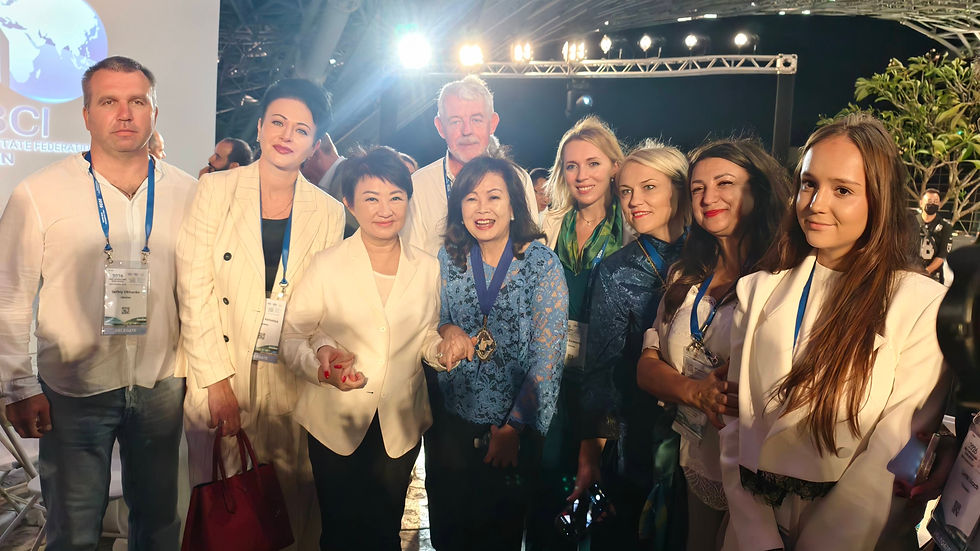
On 14–16 September 2026, a delegation of FIABCI-Ukraine participated in the FIABCI International Trade Mission in Taichung, Taiwan, bringing together real estate professionals, investors, developers, academics and public-sector representatives from around the world.

Under the theme “The New Urban Future: Beyond Technology, Toward Humanity,” the programme combined professional exchange, international business matchmaking, study visits and cultural diplomacy, with a strong focus on the future of cities, investment and human-centred urban development.

For FIABCI-Ukraine, the mission was an opportunity to strengthen international partnerships, represent Ukraine within the global real estate community and explore approaches relevant to the country's reconstruction and sustainable urban development.

FIABCI-Ukraine delegation

The Ukrainian delegation reflected the growing diversity of the FIABCI-Ukraine network, bringing together chapter leadership, real estate and valuation professionals, sustainable construction and technology experts, public-sector representatives and Young Members.

The delegation included:

  • Alissa Ban’kovska — President of FIABCI-Ukraine, Co-Founder of Rebuild Green 2030, Founder and CEO of SYNCHRO SPACE;

  • Volodymyr Shalaiev — Principal Member and Past President of FIABCI-Ukraine, Vice President of the Ukrainian Society of Appraisers and Co-Founder of the first FIABCI-Ukraine chapter;

  • Kateryna Pylypchuk — Vice President of FIABCI-Ukraine and Strategist at Modulina Straw Panels;

  • Dmytro Kovhanich — Past President of FIABCI-Ukraine, President of the FIABCI European Committee and Founder of PIXUB;

  • Serhii Okhonko — Public Sector Member of FIABCI-Ukraine, representing the Chernihiv region;

  • Inna Perekrest — Head of the Audit Committee of FIABCI-Ukraine;

  • Serhii Drach — Vice President of the FIABCI-Ukraine Young Members Committee and Investment Attraction Specialist at TERWIN Group;

  • Tetiana Voronina — Member of FIABCI-Ukraine and Director of MIZUI Ukraine.

The delegation also included representatives of the younger generation — Serhii Okhonko Jr., Alina Perekrest and Petro Pylypchuk — giving them an opportunity to experience the international FIABCI professional environment and engage with professionals from different countries and disciplines.

FIABCI-Ukraine's newly joined Overseas Member from Poland, Anna Sulińska, Co-Founder of AHA Real Estate, also participated in the mission.

Her participation gained particular significance in Taiwan: the initiative to establish a new FIABCI chapter in Poland received approval from the FIABCI International Board of Directors. Anna initially joined the global federation through FIABCI-Ukraine while working towards establishing a national organisation in Poland.

This development demonstrates an important continuity of growth: international relationships built through FIABCI-Ukraine are now contributing not only to the development of the Ukrainian chapter but also to the expansion of the FIABCI network in Central and Eastern Europe.

Three days of international professional exchange

The Trade Mission opened on 14 September with registration, networking and the official Welcome Reception in Taichung, bringing together the international FIABCI community and representatives of Taiwan's real estate, academic and public sectors.

The main professional programme on 15 September, hosted at Feng Chia University, included keynote presentations, a Business Networking Forum and discussions on global real estate development, investment, innovation and the changing role of the built environment.

A major practical component was RE KEY B2B Matchmaking. Participants created professional profiles, identified relevant counterparts and followed individual schedules of one-to-one meetings. The format provided a structured platform for developing cross-border business contacts, investment opportunities and professional partnerships.

For FIABCI-Ukraine, these meetings were particularly relevant to its work on reconstruction, sustainable development, investment, housing, construction technologies and cooperation between Ukrainian municipalities and the international real estate community.

From professional dialogue to projects on the ground

On 16 September, the programme moved from professional discussions to study visits across Taichung.

Four thematic routes explored different dimensions of the city's built environment:

Cultural Tour — Li Manor Art Museum, POUYUENJI Hills and Dongshi Hsu Liang-Yu Library;

Study Tour — Pu Shan Village, Taiping Yuxian Phase II Social Housing and Lufu Zhisen;

Award-Winning Development Tour — including Taichung Green Museumbrary and selected residential developments;

Architectural Study Tour — Dongshi Hsu Liang-Yu Library, Season Arts Education Institute and THE JINRAY development.

The visits offered practical examples of how Taiwan integrates architecture, housing, public infrastructure, landscape, technology and community needs — themes directly relevant to the long-term reconstruction of Ukrainian cities and communities.

Cultural diplomacy and Ukraine

International professional cooperation within FIABCI also extends beyond formal business meetings.

During FIABCI Cultural Night, national delegations presented their countries and traditions. FIABCI-Ukraine represented Ukraine in national dress and received first place in the national costume competition.

The cultural programme became another opportunity to maintain Ukraine's visibility within the international professional community and strengthen relationships between national chapters.

Beyond the official Trade Mission, the Ukrainian delegation also visited Taipei, Taichung and Kaohsiung, gaining broader exposure to Taiwan's urban development, architecture, infrastructure, mobility, technology and cultural identity.

From Taiwan 2013 to Taiwan 2026

The mission also carried a symbolic connection with FIABCI-Ukraine's own international history.

Taichung hosted the FIABCI World Congress in 2013, an event that played an important role in establishing relationships between Ukrainian members and the wider FIABCI community.

Thirteen years later, FIABCI-Ukraine returned to Taichung with a substantially expanded delegation representing different generations and sectors of the real estate ecosystem.

At the same time, Taiwan became the place where the initiative to establish a new FIABCI chapter in Poland, developed with the involvement and support of FIABCI-Ukraine, reached an important institutional milestone.

The continuity is significant: from relationships created through FIABCI, to stronger national chapters, to cooperation between countries, and ultimately to the emergence of new FIABCI structures.

International networks for Ukraine's reconstruction

For FIABCI-Ukraine, participation in international Trade Missions is directly connected with its wider work on Ukraine's recovery.

Reconstruction requires not only financing and construction capacity, but also access to international expertise, technologies, investment models, professional networks and tested approaches to sustainable urban development.

The Taiwan mission provided a platform to present Ukraine internationally, build new professional relationships, exchange expertise and identify practices that can be adapted to Ukrainian cities and communities.

FIABCI-Ukraine expresses its gratitude to FIABCI-Taiwan, the organisers, Taichung City Government, Feng Chia University, partners and volunteers who made the programme possible, with special recognition to Lily Chang for her leadership and long-standing contribution to connecting the international FIABCI community.

The 2026 Taiwan Trade Mission demonstrated the value of FIABCI at its most practical: connecting professionals, cities, countries and generations — and turning international relationships into opportunities for long-term cooperation.


НОВИНИ: Blog

+380 (063) 266 0331

  • facebook

Legal address: Zdolbunivska 7, of.7 Kyiv Ukraine 02081

​

©2017-2026 by FIABCI-Ukraine

bottom of page